Showing posts with label reading challenge. Show all posts

Sunday, 24 June 2012

S.S. Van Dine - The Winter Murder Case (1939)

"You live for crime and suffering. And you adore worrying. You'd die of ennui if all were peaceful."

The Winter Murder Case, the last entry in the Philo Vance series, is a much shorter book than the other mysteries of Willard Huntington Wright (alias S.S. Van Dine), running about 160 pages. As an introductory essay explains, Wright developed each of the Philo Vance mysteries in three stages; a long synopsis, the development of the synopsis into an approximately 30,000 word manuscript, and finally a further working of character, dialogue and atmosphere resulting in the finished mystery. Owing to Wright's death on April 11, 1939, The Winter Murder Case never received the final fleshing-out so that some of the trademarks of an S.S. Van Dine title are absent, such as the pseudo literary footnotes and long-winded Vance lectures. This removes some of the insufferability and humanizes Vance (which might be an inducement for some readers, I prefer Vance's full-on conceit), although some of the events of the novel also accomplish this. It's hard to imagine the Philo Vance of the earlier novels acting as the master of ceremonies for an amateur winter carnival variety show, but he does this in The Winter Murder Case--and on ice skates no less!

In The Winter Murder Case, Vance is invited to a house party hosted by wealthy Carrington Rexon who is mistrustful of some of his other guests in proximity to his fabulous emerald collection. His suspicions are given extra weight when one of the estate guards is found dead. This final S.S. Van Dine mystery is an improvement over its predecessor, The Gracie Allen Murder Case which, like that book, was written with a specific movie actress in mind--in this case, Olympic skating champion turned movie star Sonja Henie. While there are many scenes involving skating, the winter theme is merely window dressing and doesn't play an appreciable part to the mystery (it easily could be The Summer Murder Case). Nobody is stabbed or has their throat slit with an ice skate (alas!). In addition to the shortness of the novel, the economy of the mystery itself gives The Winter Murder Case the feel of a short story blown up to novella length. A brisk read but inessential to the S.S. Van Dine canon. (The publication is also padded out with Van Dine's Twenty Rules for Writing Detective Stories and it's amusing to see how many of his own rules Van Dine transgresses).

I have now finished all the Van Dine novels (and basically in order. I suspect The Greene Murder Case was the only one I read significantly out of sequence) with my favourite being The Kennel Murder Case. Seeing some of the divergent opinions on that title makes me want to reread it as it's at least ten years since I completed it .


Sunday, 10 June 2012

Ben Benson - The Affair of the Exotic Dancer (1958)

I've enjoyed Benson's series of mysteries involving Ralph Lindsey which are a combination of police procedural and bildungsroman. Lindsey is a young Massachusetts state trooper who not only makes mistakes at the outset of his career but also pays the price for having made these mistakes. I picked up The Affair of the Exotic Dancer thinking it was a non-series mystery but soon discovered that it features Benson's other series character, Captain Wade Paris of the Massachusetts police; thirty-something, fair, diplomatic, hardened by experience, the type of police veteran into which the callow Ralph Lindsey might develop.

The shooting death of a small business owner is the crime that Paris investigates in The Affair of the Exotic Dancer. However, this novel is not a who-done-it. Rather the story alternates between the police routine work and chapters entitled The Suspect which give the killer's backstory, so that early on the reader knows the identity of the killer and eventually the motive for the crime. It is to Benson's credit that, even knowing this information, the reader's interest is held by this no-frills police story.

Bill. S. Ballinger - Formula for Murder (1958)

While the cover blurb for Formula for Murder promises a "strikingly different kind of sleuth", vanMars (no first name given unless I missed it) is your typical Golden Age amateur; elegant, well-dressed, erudite, a New York City resident with friends in high places. Maybe not typical in all things. I don't recall Philo Vance ever ingesting magic mushrooms to help clarify his thoughts on a case as vanMars does in this novel...

Formula for Murder is a mystery involving suicide. Marcia Graham, a writer for Chic magazine (and presumably vanMars's love interest, although like many detectives he comes across as asexual and the relationship platonic) has been given the unusual assignment of authoring an article dealing with the study of a suicide. Unsure that she can do such a story well Marcia requests vanMars's help feeling that, with his background as a theoretical mathematician, his "scientific, detached attitude" will be a benefit to the writing of the article. Inquiring as to whether a case has been selected, Marcia replies that she'll be guided by circumstance. The next suicide story in the papers will be the one that she'll follow up.

Two days later Marcia has her story; Julian Hare, a former restaurant owner, has leaped from the Brooklyn Bridge in the early morning with two witnesses to his death. After getting the background of the case, Marcia is puzzled. "He wasn't really sick, he wasn't really broke, he wasn't really in any trouble." Even more puzzling is the link to another death. Julian's wife has been involved with an actor who was found murdered later that evening. How are the two deaths related?

Formula for Murder is a short yet solid mystery. vanMars lacks the obnoxiousness that characterizes many other gentleman detectives and the mystery plot, while obvious in some regards, is handled sufficiently well. The book takes its title from vanMars coming up with a formula for murder while in a trance state which, while novel, is basically nonsense.

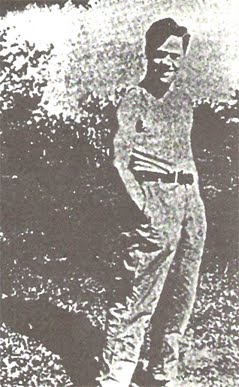
Pictured is the author photo from the back cover. It's easy to visualize Bill S. Ballinger as vanMars.


Wednesday, 25 April 2012

Spencer Dean - Murder on Delivery (1957)

Lily Inez, beautiful television star, is set to receive a very exclusive gift from the Sak's-like Amblett's department store--a 100,000 blue sable mink coat which is to be delivered on her birthday by two employees of Amblett's. The coat, however, is hijacked at Lily's apartment, the two employees are missing and Don Cadee, the head of Ambletts' security suspects that Lily and her manager have more knowledge about the theft than they want to reveal. The knowledge that this pair has proves to be rather ludicrous, but without this twist there wouldn't be much to the story. Dean, to his credit, doesn't tie everything neatly up at the conclusion.

More information on the series can be found here.

Sunday, 22 April 2012

Frank Kane - Syndicate Girl (1958)

"The syndicate runs this town. If they say go, you go. If they say jump, you damn well better jump. If they say you die, don't start reading any continued stories."

In a previous post I observed the disparity between the plot summary and cover artwork of a Rae Foley Mr. Potter novel, seemingly to make the book more palatable to a romantic suspense fan. Like that book, Syndicate Girl has a presentation at odds with its actual content. The cover blurb (She was as tough as the hoods she worked with--until she met a man who made her feel like a woman) along with the accompanying illustration of a long-legged blonde seductively posed on an armchair with a cigarette dangling from her fingers, would suggest that the novel is a crime melodrama involving the redemption of the syndicate girl (with perhaps a hint of risque action.) The trouble is threefold; the syndicate girl doesn't reform, doesn't meet a man who makes her feel like a woman, and since she isn't discovering her latent womanhood, there's no risque lovemaking either. Actually, the problem might be fourfold as the syndicate girl, Mary Lister, isn't even the main character in the book. That honour belongs to Mal Waters, a young and naive district attorney (and the future son-in-law of the mayor) who becomes involved in the battle against organized crime in a small city and the fight to prove that the suicide of a policeman was actually a mob hit tied to a corruption probe.

One's enjoyment of SG will depend on how much one can make allowances for the actions of Mal Waters. While he is supposed to be naive, a puppet placed in office by the crime-ridden administration, most of the story depends on the character doing foolish things such allowing himself to be set-up or revealing his plans to those he shouldn't trust (even though he learns early on about the duplicity of those close to him). Mal's development as a character is in contrast to what the blurb promises about Mary Lister: a "nice: guy who has to become as tough as the hoods whose downfall he wants to bring about, although the Mickey Spillanesque ending can be predicted early on.

Wednesday, 11 April 2012

S.S. Van Dine - The Gracie Allen Murder Case (1938)

"So you want to be a detective" he said cheerfully. "I think that's an excellent idea. And I'm going to give you all the help I can. We'll work together; you shall be my assistant, so to speak. But you must keep very busy at it. And you mustn't let anyone suspect that you're doing detective work--that's the first rule."

I love the Philo Vance mysteries. I love Gracie Allen. I love Philo and Gracie together. But I was greatly disappointed with The Gracie Allen Murder Case as the mystery, about the discovery of a body in a restaurant with criminal connections, was so thin and featureless that I kept waiting for something interesting to happen story-wise. One over-the-top chapter involving a gangster's metaphysical ramblings should appeal to Van Dine aficionados but this is easily the least of the Philo Vance titles that I've read (although I've yet to read The Winter Murder Case). Perhaps it worked better as a film.


John Rhode - Hendon's First Case (1935)

"Not content with a case of housebreaking, you want to tack a murder on to it."

Hendon's First Case is the Dr. Priestley novel which introduces Jimmy Waghorn, a Cambridge graduate with an unremarkable academic history and a lack of ambition who, after his father was ruined in a financial crash, decided to enroll in the new police college at Hendon. Eventually coming under the mentorship of series regular Inspector Hanslet, Jimmy is given the opportunity to distinguish himself when Hanslet receives news of a break-in. Upon arriving at the address, Jimmy learns that the break-in occurred at the workspace occupied by two research chemists, Harwood and Threlfall, and that they were dining together at a restaurant when the break-in occurred. Harwood, who returned to the laboratory alone after dinner, speculates that a rival might have entered  the premises to steal or impede their research. But there is a further complication in the investigation. Harwood appears to be suffering from food poisoning and Waghorn later receives the disconcerting news that Threlfall was admitted to a hospital shortly after dinner and died from ptomaine poisoning. The ptomaine is traced to their dinner at the restaurant and, while Hanslet concludes that the meal could not have been deliberately poisoned, Waghorn is not so sure that it is not a case of murder.

The appeal of Hendon's First Case, apart from the introduction of Waghorn, lies in the mystery of how Harwood and Threlfall were poisoned. However, the means is obviously and clumsily introduced in testimony, so I'd characterize this as a lukewarm Dr. Priestley novel. There is an interesting discussion on deciphering codes however.


Wednesday, 4 April 2012

Rae Foley - Where is Mary Bostwick? (1958)

"What's up?"
"Santa Claus. I have to see him about a dead man."

Like Margaret Erskine, Rae Foley is an writer  who found herself repackaged by publishers during the gothic boom of the sixties and seventies as an author of gothic mysteries. Given, in paperback editions, cover artwork featuring worried-looking women in evening gowns, dark and spooky settings and plot descriptions emphasizing danger and romance, a casual reader might be surprised to find out that Foley's main series character was a male detective who is sometimes compared to Albert Campion. Like Campion, Mr. Potter (first name Hiram)  is wealthy, fair-haired and has a bland unrevealing face, although he is more neurotic and considers himself to be a "catalytic agent". The plot summaries of these gothic paperbacks fail to mention Mr. Potter, instead building up the involvement of supporting female characters (and distorting the plots to make them more appealing to the fan of gothic romances).

In Where is Mary Bostwick?, Mr. Potter has just returned to his native New York City and is surprised to read in a newspaper that, despite not knowing anything about the case, he is involved in the search for a missing heiress. Mary Bostwick was an average university student before being left a fortune by her unscrupulous and estranged father. However, when the will is read, Mary has been missing for months. As his lawyer is involved in the search, Mr. Potter decides to lend his peculiar talents to the investigation, a pressure-filled task as they only have twenty-nine hours to find Mary before the fortune passes to the other heirs. The lawyer, Adam Eden, assures Mr. Potter that the other heirs knew nothing about the will previously and therefore could not have murdered her (although murder will play a part in the case). The further involved he becomes in the search, the more Mr. Potter believes that Mary Bostwick is deliberately hiding, but for what reason?

Where is Mary Bostwick? depends on a number of coincidences to propel the storyline (Mary makes an obvious cameo appearance early on) for which I could forgive the author. However, the "big reveal" about why Mary is hiding is ludicrous and sinks the novel. Still, I like the character sufficiently enough and would read another Mr. Potter mystery (and hope for a better conclusion).

Anthony Abbot - About the Murder of the Clergyman's Mistress (1931)

"I would like to have impressions taken of the paws of this cat."

The well-dressed and erudite Thatcher Colt has an advantage over other similar detectives of the 1930s. Unlike the amateur criminologists who often had to intrude upon the police investigations and were at the mercy of wrong-headed decisions, Colt is able to avoid these problems. After all, he is the Police Commissioner of New York City.

In About the Murder of the Clergyman's Mistress (who can resist that title?), Colt investigates not only the death of the titular lady but also that of the clergyman himself, both bodies discovered in a row-boat drifting down the East River. His inquiries are hampered by the reticence and hypocrisy of the Reverend Timothy Beazeley's family and congregation as well as the glib explanations of the family's lawyer (in the most entertaining character interactions of the novel).

While clearly Van Dine inspired, Thatcher Colt is less insufferable than Philo Vance (which perhaps takes some of the humour out of the novel through a lack of over-the-top personality and conflict between a snooty detective and the police), although he does engage in the same Philo Vancian mystification of his chronicler. Unsurprisingly, with a lead character who heads the police department, there's a greater emphasis on police procedure than in the Van Dine novels.

Sunday, 1 April 2012

Brett Halliday - She Woke to Darkness (1954)

"If she was a gal who passed out on her third Martini and developed nympho tendencies--that made it all the more interesting."

As the cover proudly proclaims, this is Mike Shayne's twenty-fifth case and it has a trifold narrative structure that sets it apart from the previous twenty-four. She Woke to Darkness opens with Brett Halliday recounting his experiences at the April 1953 Edgar Awards Dinner (which provides cameos from such luminaries as Frederic Dannay). Criticised as being a boring old-timer by several younger and arrogant MWA members, Halliday is pleased to be introduced to Elsie Murray, a fan of his detective novels, and after a brief conversation, accepts an invitation back to her apartment. Elsie is more than a mystery fan however; she's also an aspiring author with an uncompleted manuscript which she claims is based on a real-life experience. After their evening is interrupted by a telephone call (which Halliday assumes to be from a boyfriend), Brett  heads back to his hotel room and begins to read Elsie's novel and SWTD then alternates between Halliday's narrative and the incidents described in the manuscript. Elsie's mystery novel tells the story of a young woman, Aline Ferris, who wakes up during the night, after having one too many drinks, in a hotel room with a man's corpse in the bathroom. Aline doesn't recognise the man, flees the hotel and tries to reconstruct the events of the evening and discover the man's identity and who killed him.

Flattered by her attention, Halliday phones Elsie to give her opinion of the opening chapter of her manuscript and is surprised by two things. Firstly, that a man answers the phone, and secondly, that the man's voice has the official sound of a policeman. Worried by this, Brett phones a friend, true crime author Edward Radin who has contacts within the police department, to discover why a policeman would be at Elsie's apartment in the early hours of the morning. Radin promises to find out and phones back with the shocking news that Elsie has been strangled. Realising that he's about to become the police's main suspect, Brett phones Mike Shayne, a real-life detective whose cases he has been chronicling, for help in clearing his name. Brett is convinced that Elsie and Aline are one the same person, that Elsie was involved in a recent murder case and that the manuscript holds to key to discovering her murderer. The latter part of SWTD is the third-person account of Shayne's investigation.

She Woke to Darkness, with its placement of actual mystery writers into a fictional murder case, is a treat for Brett Halliday fans (who will also appreciate the in-jokes involving Helen McCloy and Matthew Blood) although with Shayne not appearing until well-past the half-way mark it feels more like a Mike Shayne novelette. The investigation, juxtaposing the manuscript with the "real-life" characters and locations is also a clever idea but one which is kept relatively simple (perhaps to bring the book under 200 pages).

Thursday, 29 March 2012

Henry Bellamann - The Gray Man Walks (1936)

"What are you looking for?"
"His head, man, his head. It's gone. His head isn't here."

Which of the following is the best indicator of the quality of this mystery? (a) The Gray Man, a legendary spectre whose appearance on an eerie island foretells misfortune (b) Miss Euphemia Clay, an acerbic spinster detective or (c) Kizzah the conjure man?

If you guessed (c) then give yourself a gold star! I had reservations about buying The Gray Man Walks after reading a plot summary which mentions Kizzah the local conjure man. Warning bells went off that the book would probably contain some nasty stereotypes and tedious-to-read "coloured" dialect but I bought TGMW hoping that the supernatural element and the presence of a Hildegarde Withers type detective would counter the unpleasant aspects. I found, however, that the legend and appearance of the Gray Man didn't provide much atmosphere and that Euphemia Clay didn't get enough book time, leaving the reader with a sheriff  who uses the n-word far too many times in the course of the book and non-white characters who are at best devious, suspicious and superstitious and at worst murderers, drug dealers and wife beaters. Yecccch!

Mystery-wise, the plot centres around the appearance of the Gray Man, the beheading of one of the island's residents and the investigation into  his murder by the man's sister, Euphemia Clay. But the mystery is fair and doesn't have any momentum to it. A hard-to-find title and deserving of its obscurity.

Wednesday, 28 March 2012

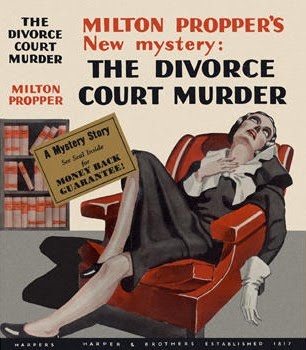
Milton Propper - The Divorce Court Murder (1934)

Milton Propper is an author whom I find especially troubling. I thought that the first book of his that I read was "okay". "Meh" was how I felt about the second. However I rather enjoyed my third and fourth encounters with his Tommy Rankin series (even the one with the railway time-table...shudder!) which raises the question: were these Proppers better than the earlier ones I read or had my critical faculties (providing I had any to begin with) taken a long vacation? Contrary to his meagre critical reception, I think that his mysteries do have some merit.

The Divorce Court Murder provides an interesting look into the mores of 1930s Philadelphia. Surprisingly, the setting is not a law court but rather the offices of a legal firm where the socially prominent Adele Rowland is suing her husband for divorce, bringing evidence against him that he has been carrying on an extramarital affair with her secretary, Jill Edmond. It is this accusation of adultery that results in the case being heard in a private law office:

"Rankin was sufficiently familiar with the peculiar divorce law of his state...In Pennsylvania , the proceedings were generally private, instead of being held in open court before a judge and jury. Some member of the bar, called a 'master', was assigned by a justice to listen to the facts of the complaint, and present his findings to him; the court usually followed his recommendation, whether for or against the divorce...With one exception this system did not preclude jury trials where both parties preferred one. There could be no public hearing, if the grounds involved such details of immorality, profligacy or unchastity as to make their disclosure prejudicial to public morals."

Initially, Allan Rowland made no attempt to contest Adele's suit but, as the story opens, he is now attempting to take advantage of another peculiarity of the divorce law; if both parties have been unfaithful, the divorce will not be granted (the reasoning being that divorce is a privilege and will only be granted when the parties deserve one) and he has brought a witness with him to testify that his wife has also been involved in an adulterous relationship. When his lawyer attempts to bring her from another room where she has been waiting, the witness, the equally socially prominent Barbara Keith, is discovered chloroformed to death. Suspicion is then divided among Adele, her lawyer, her alleged lover and Keith's husband who is also discovered to have been in the law offices that day.

As in the other Propper titles, the investigation is carried out by the youthful looking Tommy Rankin who, lacking the brilliance and insouciance of other detectives of his era, relies on perseverance and thoroughness to solve his cases. While Propper is often maligned for his lack of characterization, Rankin and the other characters who populate The Divorce Court Murder are no worse than many British "Inspector Mundane of the Yard" mysteries although his prose will never be considered stylish or witty. While Propper is occasionally praised for his plotting (Francis M. Nevins contends that "his best books hold some of the intellectual excitement of the early novels of Ellery Queen"), I'm not sure that I found all the twists and motives of TDCM entirely credible but the mystery was a fairly engaging puzzle for the most part.

Thursday, 22 March 2012

Kathleen Moore Knight - Death Blew Out the Match (1935)

"One moment--brilliant sunshine, shimmering sea, the pipe and whistle of birds, the quiver of a million growing things; the next--death and horror."


The first of the author's Elisha Macomber mysteries, Death Blew Out the Match is set on the Cape Cod island of Penberthy where recently unemployed Anne Waldron and her friend Hazel "Kerch" Kershaw have come to stay at the Waldron cottage. Their plans for an idyllic summer stay are shattered however when they discover the body of caustic playwright Marya Van Wyck who has unflatteringly portrayed several of the locals in a recent stage success. Marya is found in her cottage in front of the fireplace (unlike the dust jacket illustration), a charred match still held between her thumb and forefinger. Kerch, a nurse, thinks the death suspicious and an autopsy establishes Marya's death by cyanide of potassium poisoning. However the autopsy also shows no traces of food in her stomach or mouth . How was the poison introduced into Marya's system? Anne soon turns detective (her efforts describe as "philovancing") with her attention firmly focused on Mr. Hyland, a recent arrival to Penberthy.

I was disappointed with Death Blew Out the Match. While quick-tempered Anne Waldron's narration and investigation are for the most part enjoyable, much of the focus is centred on events that turn out to be unconnected with Marya's murder which is hastily (and rather accidentally) resolved. A paucity of suspects is also a weakness and the method of poisoning is more goofy than clever. Hopefully Elisha Macomber is better served in the next of his mysteries as his character could easily have been written out of this novel without a substantial difference to the plot.

Fans of old time radio can listen to an adaptation of the novel here.

Monday, 19 March 2012

Mabel Seeley - The Crying Sisters (1939)

Janet Ruell is bored. A small town librarian whose only suitor is a dull bank teller, Janet vows that she'll take any chance for excitement that comes her way on her vacation. Stopping at a Minnesota tourist camp, she meets Steve Corbett and takes him up on an unusual proposition: to accompany him, a stranger, to the Crying Sisters Lodge, stay with him in a cabin and look after his son Cottie. While the offer seems innocent enough, Janet suspects that Steve has a different motive for visiting the resort other than relaxation and the gun that he gives her for protection makes her even more uneasy and puzzled. The first night in their cabin, Janet is awakened by a woman's scream and finds Steve's cot empty and the cabin locked from the outside. Could her new employer be a murderer?

The Crying Sisters, Mabel Seeley's second mystery, contains many of the trademarks of woman-in-peril novels; a sullen romantic interest who may be up to something sinister, a heroine who ignores common sense by putting herself in danger and who, despite collecting many clues, can't quite piece them together to solve the mystery, and a final attempt on the heroine's life. However, Seeley does play with some of the conventions and Janet proves to be tough and capable in a dangerous situation, lifting this mystery a notch above other similar novels.


This title and several of Seeley's other mysteries are readily available in new editions.

Wednesday, 14 March 2012

A New Challenge with Old Books

I've decided to tackle a new theme in the Vintage Mystery Reading Challenge (as I recently completed the Cherchez le homme theme). I'm going to attempt the Murderous Miscellany challenge with my theme being "Pocket-sized Murder" as I'd like to read some of  my unread 40s and 50s smaller-sized paperbacks. First up...Brett Halliday...

Monday, 12 March 2012

M.V Heberden - Murder Follows Desmond Shannon (1942)

"...it looked somewhat as if murder investigations in St. Callista conducted themselves. And, he thought grimly, conduct itself it could. He was on vacation."

After several years of tiring private eye work, Desmond Shannon finally takes a vacation to the island of St. Callista in the British West Indies but his vacation proves to be anything but restful when he unwillingly heads the investigation into the poisoning of one of the island's few white residents.

Although Shannon is a private eye, the background and cast of characters of the book make it similar to a British village mystery. In St. Callista Shannon undertakes the murder investigation among the vicar, his sister, several estate owners, a spinster and various other residents who congregate nightly at the local club and, who for the most part, are a prejudicial and insular bunch. They are most vocal in their enmity toward Jack Howell, a pacifist and plantation owner, and Shannon allows himself to be drawn into the case to avoid the crime being conveniently pinned on Howell. While Shannon defends Howell's right of conscience against the colony's bias, the same consideration does not extend to the island's non-white residents with Shannon's attitude varying from the condescending to the outright threatening (suggesting that an island bully needs a whipping) which makes for some uneasy reading.


While the choice of victim is surprising, the mystery is rather thin and the Desmond Shannon series is much better served with a New York setting.

Pictured is the author who used her initials when writing the series, as Mary Violet isn't the best name under which  to be writing a hard-boiled mystery.

Reading Challenge Progress

I recently completed the "cherchez le homme" theme in the 2012 vintage mystery reading challenge. I'll continue to add books to the list but will probably add a new "customized" theme to the challenge.

It's also easy to guess which decade I favour...


Cherchez le homme

Sherwood King - Between Murders (1935)
Victor MacClure - Hi-Spy-Kick-the-Can (1936)
Stuart Palmer-The Puzzle of the Pepper Tree (1933)
C. St. John Sprigg - The Six Queer Things (1937)
Eugene Jones - Who Killed Gregory (1928)
Francis Beeding - The Norwich Victims (1935)
Stanley Hart Page-The Tragic Curtain (1935)
Frederick C. Davis - He Wouldn't Stay Dead (1939)
Christopher Bush - The Death of Cosmo Revere (1930)


Golden Age Girls

Virginia Perdue - The Case of the Grieving Monkey (1941)
Kathleen Moore Knight - Exit a Star (1941)
Carol Carnac - Death in the Diving-Pool (1940)
M.V. Heberden - Murder Follows Desmond Shannon (1942)

Saturday, 10 March 2012

Christopher Bush - The Death of Cosmo Revere (1930)

At first glance it appears that head of the magnificent Fenwold estate died as a result of a tree felling accident but one of the first persons on the scene (with some knowledge of tree felling technique) recognizes the "accident" as a put-up job and soon Ludovic Travers and John Franklin are covertly investigating the death of Cosmo Revere. Travers adopts the guise of a representative of the law firm which is to make preparations for the new heir while Franklin masquerades as Ludovic's personal servant which results in a two-tier investigation. Travers investigates the "upstairs" contingent of the Hall--Revere's niece and the habituès of the estate--while Franklin focuses his attention on the servants and residents of the village.


The focus of the detection is not so much "who done it" but rather "what are they up to" and while at first the set-up and the novelty of the complementary investigation (a refreshing change from the usual genius detective and his none-too-bright sidekick) holds one attention, I felt my interest wane with the slow pacing of the middle section. The novel does pick up in the last third with Travers and Franklin again acting in a complementary manner (with one discovering the identity of the murderer and the other the reason for the suspicious behaviour at the Hall) and one surprise revelation.

Best recommended for those readers who are willing to be patient with the slow progress of the novel although willing readers will find it a challenge to find an affordable copy. Scarce in the Doubleday printing and under the original British title of Murder at Fenwold.

Wednesday, 7 March 2012

Frederick C. Davis - He Wouldn't Stay Dead (1939)

"...I can't help feeling that you're getting off on the wrong foot by calling this a case of murder and body snatching."

He Wouldn't Stay Dead is the second mystery to feature Cy Hatch, a criminology professor who also happens to be the police commissioner's son and who, in his father's opinion, has a bad habit of becoming involved in the police department's cases. Aiding Hatch is Danny Delevan, a retired welterweight who is employed as Hatch's bodyguard to prevent any of the police commissioner's enemies from taking revenge against the father through the son (although Delevan is largely ineffectual in the role and functions primarily in the story as comic relief).

At the beginning of HWSD Hatch is visited in quick succession by two persons requesting his help in locating Sylvia Gregg, a witness in a car theft ring and murder investigation who disappeared shortly after being subpoenaed. One is a stripper named Dorelle who claims that her husband has helped Sylvia to disappear, the other Roy Foster, a fellow college instructor of Hatch's who has become lovestruck with Sylvia. Sensing that Dorelle is lying about her interest in the Sylvia Gregg disappearance and out of sympathy for Foster who's a nervous wreck, Hatch decides to take a hand in the case.

Visiting his father, Mark Hatch, at police headquarters for background on the case, Cy discovers that the case involves several missing persons. In addition to Sylvia, Sylvia's roommate Ruth Grayson, who has come into a million dollar inheritance and moved out of the apartment, also can't be traced and may be sheltering Sylvia. The police would also like to locate Phil Doyle, a disreputable private investigator who was seen at the Gregg apartment before she disappeared. Fortuitously, as Cy questions his father, a telephone call from Sylvia's landlady informs them that Phil Doyle is back at the Gregg apartment. As Cy. Mark and Danny arrive at the apartment, they hear a shot. Entering the apartment they discover Phil Doyle's body in the bedroom. No pulse and surprisingly, two gunshot holes in his shirt front. But the shooting gets even stranger. As the two Hatches search the apartment, Danny cries out in the bedroom. Finding the bedroom door now closed and locked, the father and son break down the door to discover Doyle's body no longer in the room and Delevan groggy on his hands and knees claiming that the corpse slugged him on the head with a gun. While Mark Hatch decides that Danny is mistaken and that someone else slugged Delevan and absconded with the body through the window, Cy is insistent that the shooting and Sylvia's disappearance are much more complex than they first appeared.


He Wouldn't Stay Dead is a winning mystery (and probably the most affordable and easiest to find of the early Cy Hatch cases). Briskly paced, humorous and fleshed out with characters who complicate the investigation--the secretary who's a little too willing to aid in the investigation, a deputy commissioner who indulges in a little eavesdropping and political backstabbing, and two hissably sadistic thugs. Hatch engages in some scientific detection and the usual rounding-up-of-the-suspects conclusion (although the astute reader will figure out what happened to Sylvia Gregg before he does). The only part that seemed underdone was an attraction between Hatch and one of the principals in the case.

Overall, a "fun" read and I look forward to the other Cy Hatch novels.

Friday, 2 March 2012

Stanley Hart Page - The Tragic Curtain (1935)

"My policy is to construct as many [theories] as possible and balance them against each other amassing every atom of evidence in support or derogation  of them all, until the correct one achieves such conspicuity that the minimum possibility of error exists."

One can tell from the preceding quote that we've entered Philo Vanceland and I'll readily admit two things. Firstly, that Philo Vance is one of my favourite detectives and, secondly, that I'm a sucker for all the second and third-rate Philo Vance wannabes that came along in the twenties and thirties.

The Tragic Curtain is the last title in Stanley Hart Page's "Christopher Hand" series and is somewhat of an improvement over the preceding title Murder Flies the Atlantic. (I was surprised to find that MFTA wasn't the last title as with it's sloppy plotting it bore the hallmarks of the "last gasp" of a series). The Tragic Curtain relies on the well-worn plot of the disposal of the heirs of an aged patriarch (in this case, business magnate Leander Holloway). First of the heirs to die is Holloway's nephew, Robert Bradshaw, who is disposed of while sitting in front of a window (thus giving the book its title). Hand, a crankier version of Philo Vance, attempts to discover the guilty before any of the other heirs are murdered, a task made more immediate when his "Watson", Ralph Clark, falls in love with Holloway's great-niece.

There's enough plotting in The Tragic Curtain to lift it over the dry spots but Page ultimately falters with a groan-inducing motive for the killer (who's rather obvious as the misdirection in the book doesn't work well). Before the ending the book was a passable time-filler. With it, it's only suitable for faux-Vance diehards like me.